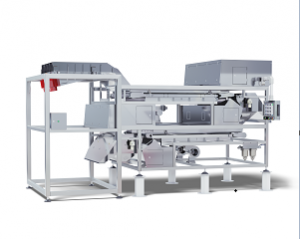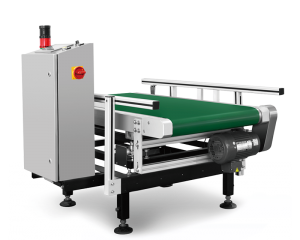

TXR-B3 High-Speed X-Ray Inspection System for Bulk Products
High-Speed X-Ray Inspection for Bulk Food Products
The Techik TXR-B3 Series inspects bulk food products for foreign contaminants and product defects. It is designed for nut kernels, dehydrated or frozen fruit and vegetables, grains, beans and seafood, combining intelligent X-ray image analysis with optional multi-channel air-jet rejection.
The system detects metal, glass, ceramic and stone as well as lower-density materials such as snail shells and twigs. It also identifies defects including shriveled or undersized nuts, insect damage, hollow kernels and breakage. Optional shape analysis, empty-shell detection and mold detection extend the inspection scope for suitable products.
Key Benefits
• Detection of organic and inorganic contaminants across a wide density range.
• Product-defect inspection for shriveling, undersizing, insect damage, hollow kernels and breakage.
• Proprietary deep-learning algorithms designed to improve low-density contaminant recognition and reduce false rejects.
• Optional 64-, 80-, 96- or 120-channel air-jet rejection configurations.
• Multi-lane inspection and targeted rejection to support higher throughput and reduce unnecessary product loss.
• 400 mm or 600 mm inspection widths with a listed conveyor speed range of 10–120 m/min.
Applications
• Nut kernels and in-shell nuts.
• Dehydrated or frozen fruit and vegetables.
• Grains and beans.
• Seafood.
Illustrated inspection examples include stones, off-type almonds and insect damage in in-shell almonds; unpitted dates among pitted red dates; and shriveled kernels, empty shells and incomplete pine nuts in in-shell pine nuts.
Intelligent Inspection and Targeted Rejection
Detect contaminants across a range of densities
X-ray imaging identifies organic and inorganic contaminants in bulk products, including metal, glass, ceramic, stone, snail shells and twigs. Actual detection performance depends on the inspected product and contaminant.
Identify defects with deep-learning algorithms
Techik’s proprietary deep-learning algorithms emulate image interpretation to distinguish contaminants and defects from acceptable product. Optional inspection functions can address shape differences, empty shells and mold.
Remove rejected material with multi-channel air jets
Optional 64/80/96/120-channel air-jet configurations provide targeted rejection across multiple lanes. The channel count should be selected according to inspection width, product flow and sorting requirements.
Inspection Capability
| Inspection Need | TXR-B3 Capability | Application Consideration |
| Foreign contaminants | Metal, glass, ceramic, stone, snail shells and twigs | Performance depends on the product and contaminant |
| Product defects | Shriveled or undersized nuts, insect damage, hollow kernels and breakage | Define the relevant defect types for each product |
| Additional quality checks | Optional shape analysis, empty-shell detection and mold detection | Select the required functions for the application |
Technical Specifications
| Specification | TXR-4080GP | TXR6080GP |
| X-Ray Tube | 210 W / 350 W (optional) | 210 W / 350 W (optional) |
| Inspection Width | 400 mm | 600 mm |
| Inspection Height | 100 mm | 100 mm |
| Best Sensitivity — Stainless Steel Ball | Ø 0.3 mm | Ø 0.3 mm |
| Best Sensitivity — Stainless Steel Wire | Ø 0.2 × 2 mm | Ø 0.2 × 2 mm |
| Best Sensitivity — Glass/Ceramic Ball | Ø 0.8 mm | Ø 0.8 mm |
| Conveyor Speed | 10–120 m/min | 10–120 m/min |
| Operating System | Windows | Windows |
| Protection Method | SUS shield | SUS shield |
| X-Ray Leakage | < 1 μSv/h (CE Standard) | < 1 μSv/h (CE Standard) |
| Protection Rating | IP66 under the belt | IP66 under the belt |
| Working Temperature | −10 to 40 °C | −10 to 40 °C |
| Working Humidity | 30–90%, no condensation | 30–90%, no condensation |
| Cooling Method | Industrial air conditioning | Industrial air conditioning |
| Rejector Mode | 64/80/96/120-channel air-jet rejection (optional) | 64/80/96/120-channel air-jet rejection (optional) |
| Air Pressure | 0.8 MPa | 0.8 MPa |
| Power Supply | 3 kW | 3 kW |
| Main Material | SUS304 | SUS304 |
| Surface Treatment | Mirror polished / sandblasted | Mirror polished / sandblasted |
Sensitivity values are based on inspection with only the test sample on the conveyor belt. Actual sensitivity is affected by the product being inspected.
Support Product Quality and Yield
Combine contaminant and defect inspection
The TXR-B3 Series combines foreign-contaminant detection with product-quality checks in one inspection process. Additional functions are selected according to the application.
Reduce unnecessary product loss
Intelligent recognition and targeted air-jet rejection are designed to reduce false rejects and limit the amount of acceptable material removed with rejected product.
Match the system to the operating environment
SUS304 construction, industrial air conditioning and an IP66 rating under the belt support operation within the listed environmental range of −10 to 40 °C and 30–90% humidity without condensation.
Inspection Examples
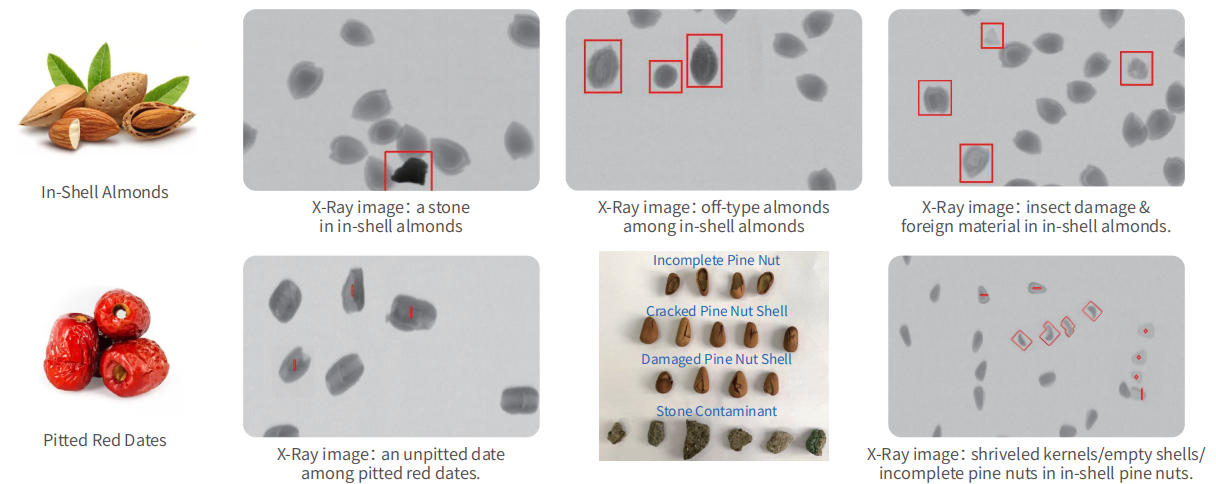
• In-shell almonds: stone contamination, off-type almonds, insect damage and foreign material.
• Pitted red dates: detection of an unpitted date among pitted dates.
• In-shell pine nuts: shriveled kernels, empty shells and incomplete pine nuts.
Inspection examples are application illustrations and do not establish a universal detection limit. Empty-shell detection is optional.
Frequently Asked Questions
It is designed for nut kernels, dehydrated or frozen fruit and vegetables, grains, beans and seafood. Illustrated examples also include in-shell almonds, in-shell pine nuts and pitted red dates.
Yes. It can identify contaminants and defects such as shriveling, undersizing, insect damage, hollow kernels and breakage. Shape analysis, empty-shell detection and mold detection are optional.
No. The Ø 0.3 mm stainless steel ball value is based on inspection with only the test sample on the belt. Actual performance depends on the product.
The primary listed difference is inspection width: 400 mm for TXR-4080GP and 600 mm for TXR6080GP. Select the width, speed and rejection configuration according to product flow and inspection requirements.
Request an Inspection Assessment
Share the product type, typical dimensions, required throughput and target contaminants or defects. Include any need for shape analysis, empty-shell detection or mold detection, together with the line layout and operating conditions, so Techik can define the appropriate TXR-B3 configuration.