
In food safety discussions, metal detection has long been treated as the default benchmark. It is fast, reliable, and widely adopted across processing lines worldwide. But as supply chains become more complex and product diversity increases, a key limitation becomes more obvious: not all hazards are metallic.
Contamination in modern food production is no longer a single-category problem. It is multi-source, multi-material, and often unpredictable. Glass shards, stones, bone fragments, ceramics, and dense plastics can all find their way into finished products—sometimes despite strict hygiene and equipment control systems.
This shift in risk profile has pushed manufacturers to rethink what “effective inspection” really means.
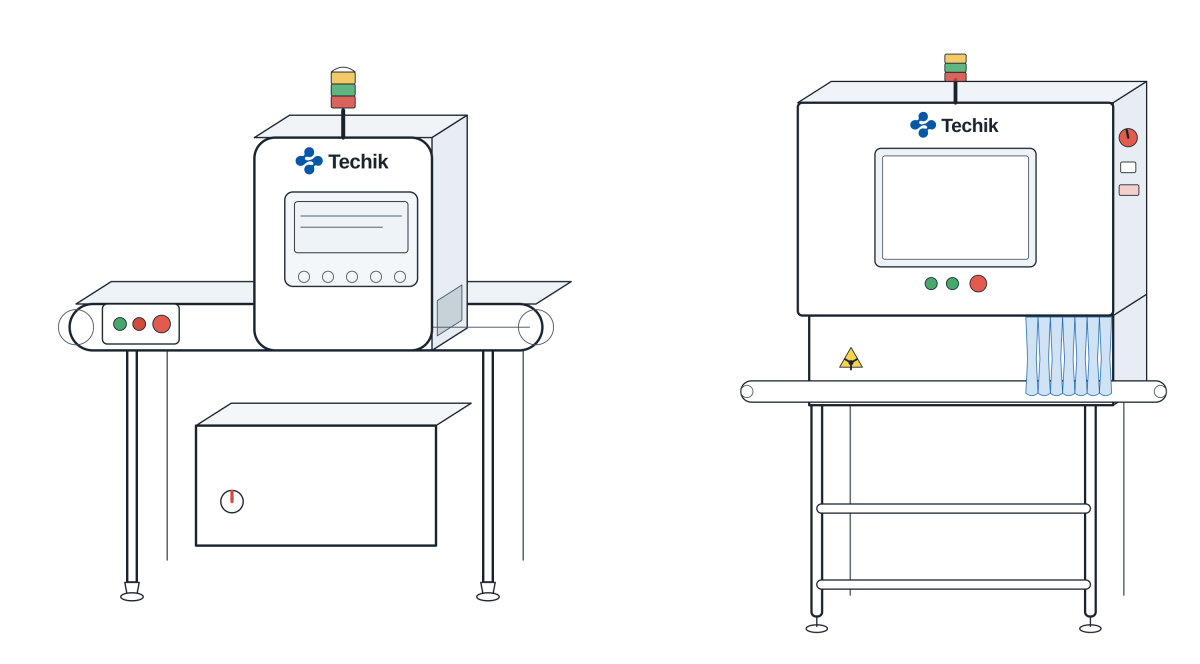
When “Metal Only” Is No Longer Enough
Metal detectors operate on a simple principle: identifying changes in an electromagnetic field caused by conductive materials. This makes them highly effective for detecting ferrous, non-ferrous, and stainless steel contaminants.
However, their detection capability stops there.
If a contaminant does not conduct electricity, it remains invisible to this technology—regardless of its size or safety impact.
In today’s production environments, that limitation matters more than ever. A single glass fragment or stone particle can cause injury, trigger recalls, and damage brand trust just as severely as metal contamination.
A Different Approach: Density-Based Detection with X-Ray Inspection
X-Ray inspection systems take a fundamentally different approach. Instead of relying on conductivity, they analyze how materials absorb X-Ray energy.
Every material has a unique density profile. When an X-Ray beam passes through a product, denser objects absorb more radiation and appear clearly distinguishable from surrounding food material. Software then interprets these differences to identify potential foreign objects.
This allows X-Ray systems to detect a far wider range of contaminants than metal detectors, particularly those that differ significantly in density from the product itself.
Glass, Stone, and Bone: Common Risks That Metal Detection Misses
Some of the most critical contamination risks in food production are non-metallic by nature.
Glass is a major example. It may originate from broken containers, lighting systems, or processing environments. Because it is non-conductive, it cannot be detected by metal detectors. X-Ray systems, however, can often identify it due to its distinct density signature.
Stone contamination is another frequent issue, especially in agricultural products such as grains, nuts, coffee, fruits, and vegetables. Despite cleaning and sorting steps, small stones can persist through processing lines. X-Ray inspection provides a reliable method for identifying these high-density foreign objects.
Bone fragments present a particularly sensitive challenge in meat and seafood processing. As demand grows for boneless or ready-to-eat products, even small bone pieces become unacceptable. X-Ray technology is widely used here because bone density contrasts clearly with muscle tissue and processed food structures.
Equipment Wear and Unexpected Contaminants
Not all foreign materials come from raw ingredients. Some originate within the production line itself.
Over time, machinery components such as rubber seals, ceramic parts, and protective coatings may degrade. Fragments from these materials can enter food streams without immediate detection.
Metal detectors are generally ineffective against these contaminants. X-Ray systems, depending on density contrast and product composition, can often identify them, adding an additional layer of protection in long-term production environments.
Packaging: Where Flexibility Matters
Modern packaging formats also create challenges for traditional inspection methods.
Metal detection can be affected by metallic packaging materials such as aluminum trays or metallized films, requiring additional system adjustments or exclusions.
X-Ray inspection is far less constrained in this area. It can typically inspect a wide range of packaging types, including metal-based structures, without compromising detection capability. This flexibility makes it particularly suitable for manufacturers adopting new packaging designs focused on shelf life, convenience, or sustainability.
More Than Contaminant Detection
Beyond foreign object detection, X-Ray systems are increasingly used as multi-functional quality inspection tools.
Depending on configuration, they can also support:
√ Missing product detection in multi-component packages
√ Fill level verification
√ Mass consistency checks
√ Seal and integrity inspection
√ Product arrangement validation
This transforms X-Ray inspection from a single-purpose safety tool into a broader quality control platform.
Choosing the Right Technology: Not Either/Or
Despite the advantages of X-Ray inspection, metal detectors are not obsolete. They remain highly effective in many scenarios where contamination risks are primarily metallic, product types are simple, and cost efficiency is a priority.
In fact, in many production lines, both technologies are used together—metal detection for basic screening and X-Ray inspection for comprehensive risk coverage.
The right choice depends on product type, packaging, risk assessment results, regulatory requirements, and customer expectations. In many cases, the decision is less about replacement and more about layering protection intelligently.
Conclusion: Expanding the Definition of “Safe”
Food safety today is no longer defined by detecting a single type of contaminant. It is defined by the ability to manage diverse and evolving risks across the entire production chain.
Metal detectors remain a critical part of this system, but they represent only one layer. X-Ray inspection expands that layer into a broader detection framework capable of identifying glass, stone, bone, and other high-risk foreign materials that traditional systems cannot see.
As manufacturers continue to balance efficiency, safety, and product innovation, inspection technology is shifting from “metal-focused” to “material-comprehensive.” X-Ray systems are at the center of that transition.
Post time: Jun-11-2026