
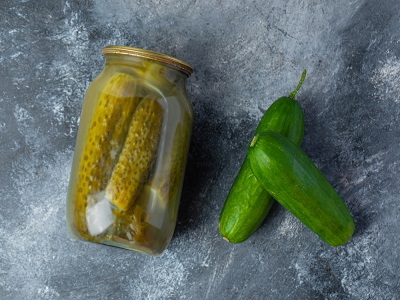
Pickled cucumbers are associated with acidity, crunch and long shelf life. That familiar jar, however, brings together an agricultural raw material, brine preparation, acidification, glass handling, filling and closure control. A weakness at any one of those stages can affect the finished product.
Unlike a uniform beverage or smooth sauce, pickled cucumbers are irregular solids submerged in liquid. They can trap soil in surface creases, carry field material into the plant and settle unpredictably inside a jar. The glass container adds another challenge: the package itself is made from one of the foreign materials the processor most wants to keep out of the food.
A useful way to understand pickled cucumber food safety is to follow the product through the factory.
It Starts with a Raw Material Grown Close to the Soil
Fresh cucumbers arrive with natural variations in size, curvature, color and surface condition. Because they grow in an agricultural environment, incoming loads may also contain soil, sand, stones, insects, stems, leaves or other field material.
Supplier programs and receiving inspections provide the first filter. Specifications may cover cucumber variety, size, maturity, visible damage, pesticide requirements and allowable foreign material. Sampling should reflect the variability of the load rather than examining only the cleanest containers at the top.
Washing removes loose material but does not solve every problem. Dirt can remain in surface irregularities. Stones may travel with similarly sized cucumbers. Damaged produce can break down during later processing and affect brine clarity or product texture.
Sorting before cutting and filling helps prevent field contaminants from moving deeper into the operation. Optical sorting can evaluate color, shape and visible defects, while other separation and inspection methods may be selected for contaminants that cannot be reliably identified by surface appearance alone.
Cutting Changes the Risk Profile
Whole cucumbers, spears, slices and chips behave differently in production. Cutting exposes new surfaces and introduces blades, guides and mechanical contact points.
A damaged cutting blade can create metal fragments. Loose fasteners or worn conveyor components can introduce additional physical hazards. Small pieces may then become hidden among cucumber slices, making visual detection difficult.
Maintenance teams should inspect blades and high-wear components at defined intervals. Missing pieces, chips or unexplained damage require immediate product control and investigation. Replacing a blade is not enough if the affected product has already moved downstream.
Cutting also changes product density and packing behavior. Spears can stand against the glass wall, while chips may overlap densely. These differences become important when the finished jar is inspected.
Brine Is a Formulation, Not Just a Liquid
The brine determines flavor, but it is also part of the product’s safety and stability system. Acid concentration, salt, sugar and other formulation factors must be controlled according to the established process.
Many shelf-stable pickled cucumber products fall within the category of acidified foods. Under applicable U.S. rules, an acidified food has a finished equilibrium pH of 4.6 or below and water activity greater than 0.85. The scheduled process may include controls for pH, heat treatment, salt, sugar and preservatives as appropriate.
“Equilibrium” is important. Measuring only the fresh brine does not necessarily establish the final pH of the cucumber pieces and liquid after they have had time to equilibrate. Product size, cucumber-to-brine ratio, formulation and processing conditions can affect the result.
Processors should follow a process established by qualified specialists and monitor the critical factors defined for the product. A foreign-body detector cannot compensate for a formulation or process deviation.
Empty Glass Inspection Deserves Its Own Step
Glass jars can be damaged in manufacturing, depalletizing, conveying or handling. Small chips may occur around the finish, thread, sidewall or base. A cracked jar can break during filling or thermal treatment.
Empty-container controls may include lighting, camera inspection, air rinsing or other validated methods. The area around glass depalletizing should be managed carefully so that a broken container does not contaminate adjacent jars or exposed product.
A glass-breakage procedure should answer practical questions:
- How far must production be stopped?
- Which open containers are considered exposed?
- How is the area isolated?
- Which tools are used for cleanup?
- How is cleanup effectiveness verified?
- Who authorizes the restart?
Using ordinary cleaning tools can spread fragments. Dedicated glass-breakage equipment and documented clearance procedures reduce that risk.
Filling a Jar Is a Balancing Act
A jar must receive the intended amount of cucumber and brine while preserving adequate headspace for closure and processing. The product should not interfere with the sealing surface.
Underfilling creates a commercial quality problem and may disturb the intended solid-to-liquid ratio. Overfilling can contaminate the jar finish, interfere with cap application or reduce headspace. Cucumbers protruding above the brine may also create an undesirable appearance or inconsistent product condition.
Irregular solids make automatic filling more difficult. A jammed spear or bridge of slices can interrupt the product flow. Operators may be tempted to make frequent manual adjustments, increasing the opportunity for handling errors or accidental introduction of foreign material.
Filler monitoring should include both quantity and presentation. Total package weight, brine level and solid content may require different checks.
The Cap Must Seal Against a Clean Finish
Metal closures add another material to the package. Caps can be dented, misapplied or cross-threaded. Liner damage and product on the jar finish may prevent a proper seal.
Closure checks may consider cap position, application torque where relevant, vacuum response and visible damage. The exact control depends on the closure system and scheduled process.
Glass jars moving through heating and cooling stages also experience thermal and mechanical stress. Poorly controlled temperature differences can increase breakage. Conveyor contact and container-to-container pressure should be managed to avoid chips and cracks.
The package should be inspected again after processing because a jar that entered the line in good condition may have been damaged later.
Why Glass-in-Glass Detection Is So Difficult
A glass fragment at the center of a jar may be easier to distinguish than one resting against the base or sidewall. At the bottom corner, the X-ray image already contains thick and overlapping glass. A fragment with an unfavorable orientation may almost disappear into that background.
Pickled cucumbers add their own image variation. Spears, seeds, internal cavities, liquid and trapped air do not form a uniform mass. Product movement can also change the image from jar to jar.
Multi-angle X-ray inspection provides different views of the same container. If a flat fragment is difficult to see from one direction, another view may reveal a more useful profile. AI-assisted processing can help distinguish package structures and normal cucumber patterns from suspicious high-density features.
Application testing should use glass taken from the actual container type whenever possible. Generic glass balls are useful for repeatable checks, but they do not fully represent the irregular shape and orientation of a real broken jar.
Other Physical Hazards Should Not Be Forgotten
Glass receives the most attention, but a pickled cucumber line may also encounter:
- Metal from cutting or filling equipment
- Stones from agricultural raw materials
- Hard mineral material
- Damaged closure components
- Plastic from containers, guides or handling materials
- Maintenance debris
Different contaminants have different detection characteristics. Some low-density plastics may be difficult to identify with X-ray technology, especially when surrounded by product of similar density. The plant’s hazard analysis should determine which controls are suitable at each stage.
A Good Jar Tells the Story of a Controlled Process
The safety of pickled cucumbers cannot be reduced to acidity alone. It depends on clean incoming produce, reliable sorting, maintained cutting equipment, correct brine preparation, controlled pH, intact glass, accurate filling and secure closure.
Finished-jar X-ray inspection adds a valuable final perspective because it can examine a sealed container without opening it. For suitable applications, the same inspection pass may also identify significant filling-level deviations.
Techik offers X-ray systemswith different beam arrangements for bottles and jars. Inclined and multi-angle configurations can be evaluated for difficult areas such as container bottoms, sidewalls, screw mouths and closures.
The right system begins with real production samples. Jar dimensions, cucumber style, brine composition, line speed and target contaminants should all be included in the test. That approach produces a far more useful result than selecting equipment from a general specification alone.
Post time: Jul-21-2026